

Growth Regime Working Group (GRWG) of the IPE Berlin
The GRWG aims at research on the main dynamics and drivers of the diverging demand and growth regimes in modern capitalism from a comparative perspective. It investigates the main demand and growth regimes and their changes both in the global North and South, and the global and regional interplay among various regimes. It also focuses on research on individual case studies.
The GRWG consists of researchers from different social sciences. The research is rooted in heterodox perspectives, including post-Keynesian economics, Marxist approaches, regulation school, dependency theory, and other critical political economy perspectives.
Research Programme
- Typologies of Growth Regime: Methodology and Empirics
- Growth Regimes and Green Transition
- Modelling Growth Regimes
- Political Economy of Growth Regimes: Dominant Social Blocs, Growth Strategies and Policy Space
Members
- Dr. Ümit Akcay
- Philip Blees
- Dr. Alessandro Bramucci
- Juan Manuel Campana
- Cara Dabrowski
- Prof. Dr. Stefano Di Bucchianico
- Dr. Petra Dünhaupt
- Daniel Feliciano Cruz, PhD
- Prof. Dr. Eckhard Hein
- Prof. Dr. Valeria Jimenez
- Dr. Benjamin Jungmann
- Gabriel Petrini
- Dr. Franz Prante
- Leonardo Quero Virla
- Prof. Dr. Ricardo Summa
- Candelaria Fernández Tucci
- Prof. Dr. Ryan Woodgate
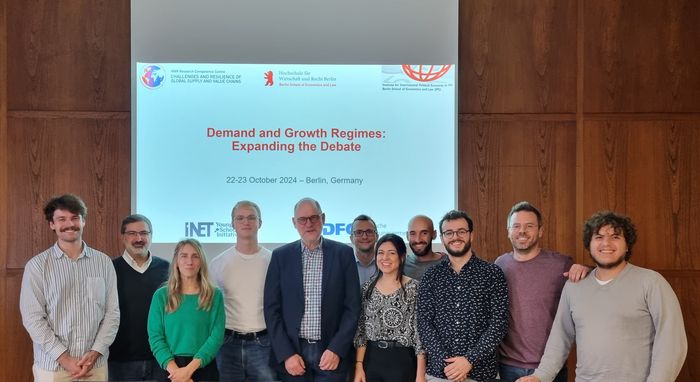
Philip Blees, Ümit Akcay, Petra Dünhaupt, Benjamin Jungmann, Eckhard Hein, Alessandro Bramucci, Valeria Jimenez, Juan Manuel Campana, Ryan Woodgate, Stefano Di Bucchianico and Gabriel Petrini at the Growth Regime Workshop 2024
Workshops
IPE Online Workshop: Frontiers in Growth Regimes Research: Theoretical Perspectives and Country Cases, 6-7.10.2022, see EJEEP Special Issue I & II
Recent Working Papers
Akcay, Ü., Hein, E. (2026): Demand and growth regimes revisited: Toward an integrated four-level research programme, Institute for International Political Economy (IPE), Working Paper 272/2026.https://www.ipe-berlin.org/fileadmin/institut-ipe/Dokumente/Working_Papers/Demand_and_Growth_Regimes_Revisited_Working_Paper.pdf
Campana, J.M., Hein, E. (2026): Macroeconomic policy regimes and the dynamics of demand-led growth regimes in advanced and emerging economies, Post-Keynesian Economics Society (PKES), PKES Working Paper 2611. https://www.postkeynesian.net/working-papers/2611/
Campana, J.M., Hein, E. (2026): Demand-led growth decomposition and trade structures: towards a spectrum of export-led models, Post-Keynesian Economics Society (PKES), PKES Working Paper 2604.https://www.postkeynesian.net/working-papers/2604/
Recent Publications
Jorquera Flores, S., & Akcay, Ü. (2026). Neoliberal Continuity and Functional Change: Growth Regimes and Social Blocs in Chile. Review of Radical Political Economics, 0(0). https://doi.org/10.1177/04866134261469260
Akcay, Ü. (2026). Political economy of Turkey’s monetary policy experiment (2018–2023): policy coalitions, monetary unorthodoxy and external constraints. Journal of Balkan and Near Eastern Studies, 1–27. https://doi.org/10.1080/19448953.2026.2633654
Blees, P. (2026). Productivity growth and class struggle in a growth regime framework—a proposal for a varieties of productivity regimes approach applied to Germany and the US from 1991 to 2019. Review of Evolutionary Political Economy, vol. 7. https://doi.org/10.1007/s43253-026-00185-5
Dünhaupt, P., Gräf, H., Jiménez, V., Jungmann, B. (2026). Lithium, leverage, and limits: Chile’s industrial policy vis-à-vis the EU-Chile free trade agreement’s energy and raw materials chapter. Journal of Economic Policy Reform, 1–20.https://doi.org/10.1080/17487870.2026.2689934
Jiménez, V., Woodgate, R. (2026). The balance-of-emissions constraint on growth: pathways to net-zero greenhouse gas emissions in a simple post-Keynesian model. Review of Social Economy, 1–29. https://doi.org/10.1080/00346764.2026.2646538
Campana, J.M., Hein, E. (2025). Eurozone governance and the German demand and growth regimes, 1999-2024. Review of Evolutionary Political Economy, vol. 6. https://doi.org/10.1007/s43253-025-00160-6
EJEEP Special Issue I
The special issue of the European Journal of Economics and Economic Policies: Intervention (EJEEP) (3/2023) on ‘Frontiers in Growth Regimes Research I: Theoretical Perspectives and Conceptual Issues’ contains six reviewed and revised contributions to the IPE Workshop on Frontiers in Growth Regimes Research from October 2022:
Editorial to the special issue: Frontiers in Growth Regimes Research I: Theoretical Perspectives and Conceptual Issues
Ümit Akcay, Eckhard Hein, Benjamin Jungmann, and Ryan Woodgate
Varieties of demand and growth regimes – post-Keynesian foundations
Eckhard Hein
Nothing new under the sun: the so-called ‘growth model perspective’
Bruno Amable
House price cycles, housing systems, and growth models
Karsten Kohler, Benjamin Tippet, and Engelbert Stockhammer
FDI-led growth models: Sraffian supermultiplier models of export platforms and tax havens
Ryan Woodgate
Dependency revisited: commodities, commodity-related capital flows and growth models in emerging economies
Michael Schedelik, Andreas Nölke, Christian May, and Alexandre Gomes
Growth regimes, dominant social blocs and growth strategies: towards varieties of export-led growth regimes and strategies in Turkey and Poland
Ümit Akcay and Benjamin Jungmann
EJEEP Special Issue II
The second special issue of the European Journal of Economics and Economic Policies: Intervention (EJEEP) (1/2024) on ‘Frontiers in Growth Regimes Research II: Country Cases’ contains eight reviewed and revised contributions to the IPE Workshop on Frontiers in Growth Regimes Research from October 2022:
Editorial to the special issue: Frontiers in Growth Regimes Research II: Country Cases
Ümit Akcay, Eckhard Hein, Benjamin Jungmann, and Ryan Woodgate
Demand and growth regimes of the BRICs countries – the national income and financial accounting decomposition approach and an autonomous demand-led growth perspective
Juan Manuel Campana, João Emboava Vaz, Eckhard Hein, and Benjamin Jungmann
A supermultiplier demand-led growth accounting analysis applied to the Spanish economy (1998–2019)
Héctor Labat-Moles and Ricardo Summa
From export boom to private debt bubble: a macroeconomic policy regime assessment of Canada’s shifting growth regime
Theodore Klassen
Macroeconomic policy regimes and demand and growth regimes in emerging market economies: the case of Argentina
Juan Martín Ianni
In search of a growth model for Italy: the failed attempt of an export-led recovery strategy?
Alessandro Bramucci
Growth regimes of populist governments: a comparative study on Hungary and Poland
Julia Kühnast
Growth models, growth strategies, and power blocs in Turkey and Egypt in the twenty-first century
Ali Rıza Güngen and Ümit Akçay
Further Publications
Akcay, Ü., Hein, E., & Jungmann, B. (2022). Financialisation and Macroeconomic Regimes in Emerging Capitalist Countries Before and After the Great Recession. International Journal of Political Economy, 51(2), 77-100. https://doi.org/10.1080/08911916.2022.2078009
Dünhaupt, P. & Hein, E. (2019). Finanzialisation, distribution, and macroeconomic regimes before and after the crisis: a post-Keynesian view on Denmark, Estonia, and Latvia, Journal of Baltic Studies, 2019, 50 (4), 435-465, https://doi.org/10.1080/01629778.2019.1680403.
Hein, E. (2019). Financialisation and tendencies towards stagnation: The role of macroeconomic regime changes in the course of and after the financial and economic crisis 2007–09. Cambridge Journal of Economics, 43(4), 975–999. https://doi.org/10.1093/cje/bez022
Hein, E. (2022). Financialisation and stagnation – a macroeconomic regime perspective, in: Wray, L.R., Dantas, F. (eds), The Handbook of Economic Stagnation, London et al.: Academic Press, Elsevier, 79-101. https://shop.elsevier.com/books/handbook-of-economic-stagnation/wray/978-0-12-815898-2
Hein, E. (2022). Financialisation, varieties of macroeconomic regimes and stagnation tendencies in a stylised Kaleckian model, Institute for International Political Economy (IPE), Working Paper 193/2022. https://www.ipe-berlin.org/fileadmin/institut-ipe/Dokumente/Working_Papers/ipe_working_paper_193-Hein.pdf
Hein, E. (2024): Demand-led growth and macroeconomic policy regimes in the Eurozone: Implications for post-pandemic economic policies, in: Jespersen, J., Olesen, F. (eds), Post-Keynesian Economics for the Future: Sustainability, Policy and Methodology, Cheltenham: Edward Elgar, 108-123.https://doi.org/10.4337/9781035307517.00015
Hein, E. (2024): Inflation is always and everywhere … a conflict phenomenon: post-Keynesian inflation theory and energy price driven conflict inflation, distribution, demand and employment, European Journal of Economics and Economic Policies: Intervention, 21 (2), 202-231. https://doi.org/10.4337/ejeep.2024.0135
Hein, E., & Martschin, J. (2020). The Eurozone in Crisis—A Kaleckian Macroeconomic Regime and Policy Perspective. Review of Political Economy, 32(4), 563–588. https://doi.org/10.1080/09538259.2020.1831202
Hein, E., & Martschin, J. (2021). Demand and growth regimes in finance-dominated capitalism and the role of the macroeconomic policy regime: A post-Keynesian comparative study on France, Germany, Italy and Spain before and after the Great Financial Crisis and the Great Recession. Review of Evolutionary Political Economy, 2 (3), 493-527. https://doi.org/10.1007/s43253-021-00044-5
Hein, E., Marpe, M., Schütt, K. (2025): Wealth distribution with and without real estate assets and mortgage debt in ten European countries – a post-Kaleckian approach, Review of Political Economy, advance access. https://doi.org/10.1080/09538259.2025.2484594
Hein, E., Meloni, W. P., & Tridico, P. (2021). Welfare models and demand-led growth regimes before and after the financial and economic crisis. Review of International Political Economy, 28(5), 1196–1223. https://doi.org/10.1080/09692290.2020.1744178
Hein, E., Prante, F., Bramucci, A. (2022). Demand and growth regimes in finance-dominated capitalism and a progressive equality-, sustainability- and domestic demand-led alternative: A post-Keynesian simulation approach, PSL Quarterly Review, 76(305), 181–202. https://doi.org/10.13133/2037-3643/18211
Hein, E., van Treeck, T. (2024): Financialisation and demand and growth regimes – a review of post-Keynesian approaches, IFSO Working Paper 32/2024, Institute for Socio-Economics, University Duisburg-Essen.https://www.uni-due.de/imperia/md/content/soziooekonomie/ifsowp32_heinvantreeck2024.pdf
Jimenez, V. (2020). Wage shares and demand regimes in Central America: An Empirical analysis 1970-2016. Institute for International Political Economy (IPE) Berlin, Working Paper, 151. https://www.ipe-berlin.org/fileadmin/institut-ipe/Dokumente/Working_Papers/ipe_working_paper_151.pdf
Jungmann, B., (2023). Growth drivers in emerging capitalist economies: Building blocks for a post-Keynesian analysis and an empirical exploration of the years before and after the Global Financial Crisis, Review of Evolutionary Political Economy, 4(2), 349-386. https://doi.org/10.1007/s43253-023-00101-1
Prante, F., Hein, E. & Bramucci, A. (2022). Varieties and interdependencies of demand and growth regimes in finance-dominated capitalism: a post-Keynesian two-country stock-flow consistent simulation approach, Review of Keynesian Economics, 2022, 10 (2), 262-288, https://doi.org/10.4337/roke.2022.02.07
Woodgate, R. (2021). Multinational corporations and commercialised states: Can state aid serve as the basis for an FDI-driven growth strategy? Institute for International Political Economy (IPE) Berlin, Working Paper, 161. https://www.ipe-berlin.org/fileadmin/institut-ipe/Dokumente/Working_Papers/ipe_working_paper_161.pd
Woodgate, R. (2022). Profit-led in effect or in appearance alone? Estimating the Irish demand regime given the influence of multinational enterprises. Review of Evolutionary Political Economy, 3(2), 319-350. https://link.springer.com/article/10.1007/s43253-021-00056-1
Woodgate, R., Hein, E., Summa, R. (2024): Components of autonomous demand growth and financial feedbacks: implications for growth drivers and growth regime analysis, Review of Political Economy, 36 (5), 1876-1893. https://doi.org/10.1080/09538259.2023.2269369
Other Events and Presentations
- Presentations at SASE Conference 2026, Bordeaux, 1-4 July 2026: Ümit Akcay “External Anchoring and Growth Models in the Semi-Periphery: An International Political Economy Perspective on Turkey”; Valeria Jimenez & Petra Dünhaupt “Industrial Policy and the Reconfiguration of the Developmental State: A ComparativeAnalysis of Brazil and Chile”
- Presentations at the 2nd Lille Post-Keynesian Conference, Lille, 24-26 June 2026: Philip Blees & Eckhard Hein “Labour market institutions, distributional conflict and productivity growth”; Juan Manuel Campana “Growth models and autonomous demand in comparative perspective: exports, government and households”; Petra Dünhaupt und Valeria Jimenez “Structural policy space and global value chain position – a framework for industrial policy in the critical materials boom”; Eckhard Hein “Finance-dominated capitalism, stagnation and global imbalances – post-Keynesian structuralist perspectives”
- Presentations at the 29thForum for Macroeconomics and Macroeconomic Policies (FMM), Berlin, 23-25 October 2025: Benjamin Jungmann, Eckhard Hein & Juan Manuel Campana “A post-Keynesian open economy model with conflict inflation, distribution, employment and external balance”; Juan Manuel Campana & Ümit Akcay “A tale of two crisis: Failed attempts to reclaim policy space from financial markets in Argentina and Turkey”; Cara Dabrowski & Eckhard Hein “Endogenous money and inflation: An introductory Kaleckian conflict inflation model”
- Presentations at the 37th Annual Conference of the European Association of Evolutionary Political Economy, Athens, 24-26 September 2025: Eckhard Hein & Juan Manuel Campana „Eurozone governance and the German demand and growth regimes, 1999-2024“; Ümit Akcay & Juan Manuel Campana „A tale of two crises: Failed attempts to reclaim policy space from financial markets in Argentina and Turkey”; Philip Blees „Towards a Varieties of Socio-economic Productivity Regimes Approach”
- Session on ‘Frontiers in Growth Regime Research – Theoretical Perspectives and Country Cases’, 26th Annual Conference of the Forum Macroeconomics and Macroeconomic Policies (FMM), ‘Post-Keynesian Economics and Global Challenges’, Berlin, 20.-22.10.2022
- IPE Political Economy Forum: From the Brief Golden Age to the Decline of the Brazilian Economy since 2015: Distributive Conflict and Stagnation Policy, 14.7.2022
- Session ‘Studies on Macroeconomic Regimes’, 25th Annual Conference of the Forum Macroeconomics and Macroeconomic Policies (FMM), ‘Macroeconomics of Socio-Ecological Transition’, Berlin, 28.-30.10.2021
- IPE Political Economy Forum: Turkey in Turbulence: Heterodoxy or a New Chapter in Neoliberal Peripheral Development?, 16.10.2023
- IPE Political Economy Forum: Turkey at the Crossroads: Economic Crisis and Political Regime, 22.6.2021
- IPE Political Economy Forum: Does European Integration Imply the End of the Continental European Model of Capitalism?, 20.1.2020